
Spurs 1 Liverpool 2 Premier League 15.09.18 Wembley.
This is not a commentary on the game. It is simply highlighting one aspect of defensive play and considering its impact on team performance. The particular incident under review did result in Liverpool’s second goal and focuses on that conundrum for defenders about when to get tight on their marker and when to drop off.
Diagram 1

Kieran Trippier’s defensive position is quite tight on Mane. Possibly looking to intercept the pass if it is made to Mane’s feet. However, in doing so, he is susceptible to the ball over the top.
Diagram 2
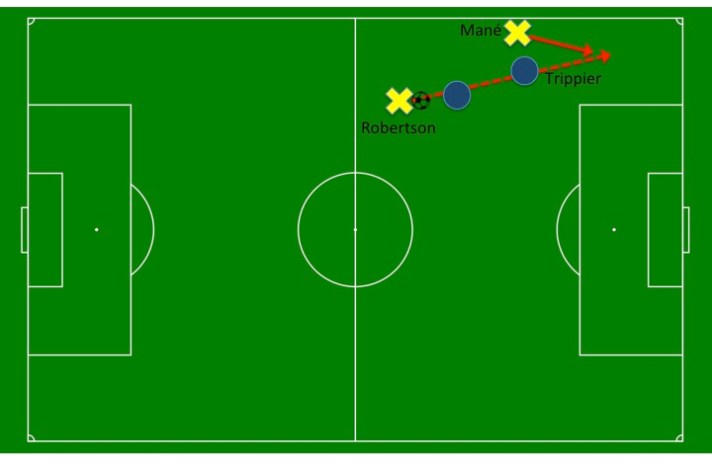
Instead of playing the ball to Mane, Robertson plays a left-footed ball over the top. Before Trippier can turn, Mane is getting clear.
Diagram 3

Trippier has lost goal-side position on Mane. Mane is now unopposed and running into the box. Vertonghen’s attempt to cut out the cross succeeded only in turning the ball against the post and Vorm was on the floor as the rebound rolled his way. He could not adjust in time, the ball squeezed through his hands and Firmino had an easy tap-in.
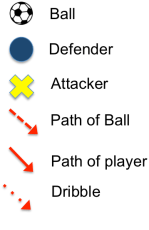
Key:
The defining moment is when Robertson plays the ball over the top. Diagram 3 clearly shows that Trippier is no longer able to provide any defensive resistance. This scenario is a common enough one and questions whether Trippier has really taken full ownership in terms of his responsibility for the marking of Mane. There is no one else who could possibly adopt this role other than Trippier.
At this moment in time, or rather while the ball is still with Robertson, Trippier should be taking sole responsibility for the marking of Mane. Effectively, he should be adopting a man-to-man marking role on Mane.
These one-on-one situations are being repeated time and again in different areas of the field. There is a split-second moment when the defender has to make the decision that this opponent is my responsibility, at least for the remainder of the particular phase of play. In order to be responsible for that opponent, one has to be goal-side of the opponent. Trippier cannot possibly be deemed to be in control of the situation. The consequences for not being goal-side are clear for all to see in the case of Liverpool’s second goal.
The mind-set of the need to maintain a goal-side position is often brought into question by players higher up the pitch. Hunting the ball in these areas, you will often see a player make an effort to win the ball but with no real thought or responsibility given to maintaining a goal-side position on this opponent. The attacking player slips the tackle and is now advancing with the ball and bearing down on the defensive unit. The defensive player who initially tried to win the ball has given up on this cause and left it to others to make good.
A pre-occupation with trying to win the ball is often the underlying cause of the attacker beating the defender. Ironically, the defender seems quite content with their work, having made an effort to win the ball. This is because maintaining a goal-side position is not regarded as being particularly important. But, it is the essence of good defending.
The habit can often manifest itself in and around the penalty box where the defender can be seen making a last-ditch lunge for the forward as they try to win the ball. The circumstances being, that the defender has not maintained a goal-side position. The defender is effectively on the wrong side of the attacker and is now trying to make amends.
It is fair to say that the concept of maintaining a goal-side position is not particularly ingrained into the psyche of modern day footballers. You might say, it never has been. The fact the defender finds themselves on the wrong side of the attacker is perhaps symptomatic of not making the decision to take sole responsibility for defending against this particular opponent in the first place.
The maintaining of a goal-side position has huge consequences in the strategy of playing the offside trap. Quite simply, a defender in the last line of defence with their back to goal could have an attacker alongside facing goal. The two are side by side. If a ball is played over the top of the last line of defence, it is quite clear who is going to get to the ball first. This is the harsh reality of prioritising a defensive line over the technique of maintaining a goal-side position.
Defences are quite good at catching opponents in offside positions. Likewise, attacking teams are becoming quite adept at beating the offside trap. Of course, the consequences of this strategy can be quite severe if the offside trap or defensive line is broken.
Upcoming blog – analysis of Premier League goals scored in the first week of the season.
 No offence intended