
Have you ever watched a game of hockey?
Structure
Team sports have more in common than you think. Hockey, for example, has a very similar structure to football; the size of the playing area and goals although smaller, are similar. There are eleven players on each side and, up until the mid-nineties hockey had an identical offside rule.
The sport, which is now played on astro turf, also adopted many of the same playing positions which originate from the old W-M formation, before 4-3-3 emerged in the sixties and then 4-4-2.
Watching hockey, one of the first impressions you might gain is the sheer pace and tempo at which the game is played. Following the abolition of the off-side rule, a new way of playing has emerged where the holding of a flat backline is no longer relevant. Much greater emphasis is placed on assuming a goal-side position on one’s opponent and, this principle, is adopted by all players in the defensive unit.
Hockey teams still adopt an initial zonal shape when it comes to defending to ensure coverage of the playing area. However, this will often develop into a man-to-man format as play gets closer to one’s own goal.
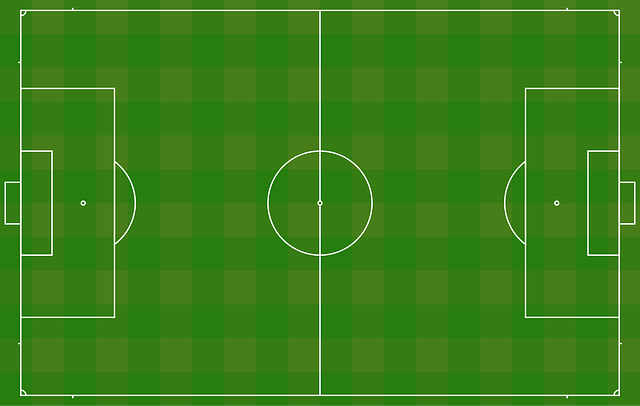
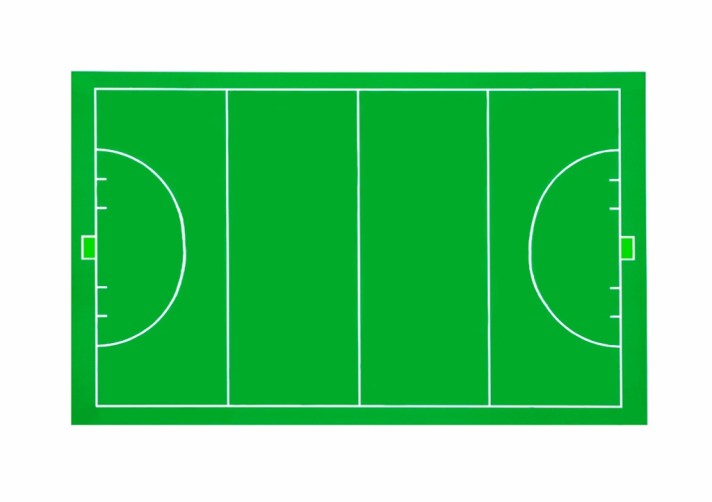
Not all pitches are the same size in football, though the preferred size for many professional teams’ stadiums is 105 x 68m (115 x 74yd).
Hockey pitches tend to be of a standard size 91.4 x 55m (100 x 60yd).
The off-side rule and football
This could be of interest to football as playing in a zonal shape with a flat backline is considered the ‘holy grail’ in football and there is barely a team, at any level, that does not set up in this way. The idea of possibly setting up in another way is regarded as a complete anathema to most people.
The prospect of playing man-to-man defence in open play has never really been embraced by football as it straddles that line between exciting and scary.
Myth
Perhaps the biggest mis-perception in football is that man-to-man marking is not possible. It is difficult to understand why there is such vehement opposition to this given that football will naturally opt to play a man-to-man strategy when defending at corners. Why not in open play?
We’re not talking about Ron-chopper Harris and man-marking seventies style. The number of goals being conceded as a direct result of either the player scoring the goal or the player providing the assist not being marked, suggest we may need a new model.
You don’t have to defend in lines, which seems to be the natural outcome of zonal defending. Rather than allowing opposition forwards to play between the lines we need to read between the lines and recognise that there is a fundamental insecurity in the lines of communication between defenders trying to organise their defence. With zonal defending, everyone seems to operate in their own distinct bubble of time and space. Man-to-man marking makes you more accountable.
With man-to man marking, it is difficult to evade responsibility. It is the element of accountability that encourages understanding and, in turn, the true glories of the art of defending.
Best of both worlds
There is no prospect of football doing away with their off-side rules. This is not being advocated. Rather, football can enjoy the best of both worlds. They can carry on adopting the tactic of playing as they do in a zonal shape with a flat backline, catching out opponents from time to time with the off-side trap. Or, they could abandon the flat back line in favour of a man-to-man defensive strategy.
The playing of off-side feels very familiar but it is fallible. It can be very productive and yet, because the whole defensive shape is based around this tactic, it can also be very constrictive. It may be responsible for not just the conceding of goals but factors relating to basic technique. Regardless of what defensive shape you choose to adopt, defence will always come down to the one-versus-one, the individual technique.
The way opposing attackers keep cropping up in the penalty area completely unmarked at least ought to lend credence to the idea that an alternative model of defending may be worth further scrutiny.
In a team man-to-man defence, an individual defender can still invoke the off-side rule by making a unilateral decision to step-up and leave the opponent in an offside position if the situation presents itself.
Less predictable
Playing different systems in one game is potentially a game-changer. The offensive pattern currently is pre-disposed to match up against a zonal defence. The introduction of a man-to-man defensive shape, throws this attacking strategy out of the window.
It doesn’t have to be all one thing or another. Once players become familiar with a man-to-man strategy it is relatively easy to flip between the two.
Some will argue that by not playing a zonal defence you are relinquishing the ability to compress the play. This is best done at source. Providing pressure on the ball is the defining principle of man-to-man. Without this, compression of play in terms of a team shape is almost pointless.
Springboard to attack
In hockey, players will often be matched up with their opposing number in man-to-man marking particularly in their defensive third of the pitch. If the ball happens to be stolen back whilst in this format, it is apparent there is an immediate area of space for the newly won ball carrier to travel in to. The player who has just lost the ball is temporarily out of the game.
In control
Confidence is king when defending. Making players take responsibility for their decisions (with man-to-man marking they are accountable) instils self-belief. Being able, and confident, to invite teams on to attack you is sometimes a necessary part of the strategy to be able to attack them. Obviously, there is more space in which to launch a counter-attack. The counter-attack should be every team’s first option when attacking.
Man-to-man in open play
The modern fixation of “playing out from the back” has brought about the counter tactic of pressing. This type of press, unlike the gegenpress,which is utilised to win the ball back immediately possession is lost rather than falling back to regroup, is often utilised as a full-pitch man-to-man defensive strategy. This is a high-energy tactic and it is a clear example of team’s applying man-to-man principles in open play.
So, it can be done.
 No offence intended