
Coaches all around the world are constantly grappling with formations to identify pockets of space that they can exploit when in possession of the ball. The most classic of these is the counter-attack that attempts to get the ball forward quickly before the defence have time to organise. This is a format that ought to be considered as a priority option for any team.
In this blog, I have identified many of the strategies that teams utilise when, and if, the counter-attack is not viable. These range from playing between the lines, that is the space between midfield and the back four or between vertical lines, between centre back and full back. There is also the freeing up of space by utilising the switch ball on either side of the pitch as described in the ‘2-7-2’ formation.
All these tactics are based on playing against zonal formations. If you play a ‘team’ man-to-man defensive formation it rather scuppers all these well-laid plans. And, it is not that difficult to do. The supposed spaces that are deemed fertile areas for getting free, no longer exist. Yes, players would need to get use to the different type of format. In some ways it is not massively different to playing zonally. However, there are a few subtle differences.
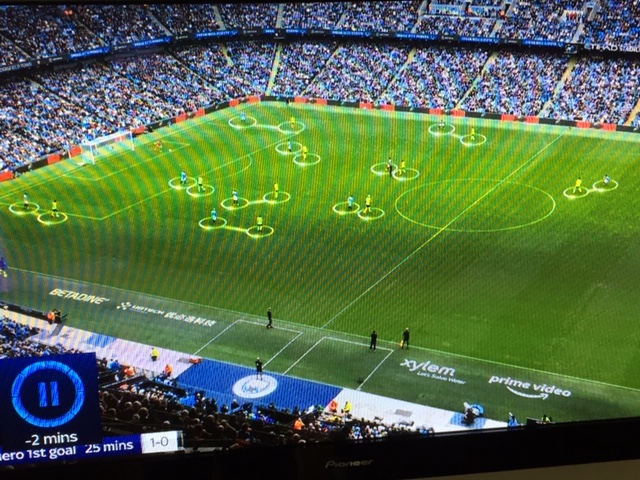
Full court man-to-man press
In the example above, the opposition are lined up in a strict full court man-to-man marking format. Because it is a dead ball situation it is relatively easy to implement. The problem is that because it is a goal kick the opposition cannot apply any pressure to the ball, namely the goalkeeper. This allows the goalkeeper to kick the ball long, bypassing the press, and leaving a potentially dangerous one-versus-one situation at the back.
This type of full court man-to-man press really ought to be implemented during open play where it is possible to pressurise the goalkeeper. With any full court press the players are isolated and it is difficult to provide support to teammates. But, man-to-man marking does not always have to conform to full court. A more sustainable model would be to play half court. Here, it is open play and the defending team have only to cover half of the area and this enables them to be more compact. The compactness allows them to provide support to one another.
Understanding man-to-man
The only reason why this type of defensive organisation has never really caught on is the fundamental misperception of confusing this team approach to man-to-man marking with the more familiar term ‘man-marking’. The major difference between the two is that the latter is an individual approach to marking opponents as opposed to a team approach. How this manifests itself is in the area of involvement where the player one is marking, is not in possession of the ball. ‘Man-marking’ has the reputation of sticking to your marker no matter what – even going to the toilet with them!
This type of approach does not work and has rightly been referred to as a fools’ game. The emphasis with the team approach to man-to-man is primarily with the opponent on the ball. There will be one player responsible for marking this opponent but other teammates all have a responsibility to support the player marking the opponent on the ball. Obviously, the defenders closest to the action will play a more prominent role. Ideally, looking to get at least two players to defend against the ball particularly when the play gets closer to one’s own goal.
In this respect, there is a zonal element to man-to-man marking. The idea is not to isolate any one defender in a one-versus-one situation. As soon as you can get a second defender in place, this changes the whole landscape and puts the defence in control as opposed to the individual attacker. At least, in theory it should do but there is some defensive technique to implement before the control element can be regarded as a given.
It is not feasible to mark all ten out field players. It is not necessary. However, it is necessary to make sure all the main providers and penalty box threats are marked. There ought to be one player at the back who is not responsible for marking any particular player and is there to sense danger and provide support where necessary.
There is another way of creating space
By the nature of the defensive formation with the team defending in a man-to-man style and largely now in their defensive third, the players from both teams are going to be more evenly distributed around the playing area.
From an attacking point of view, players are trying to find space in areas away from the ball whilst others are may be looking for a short pass option. With man-to-man, once you get a turnover it’s absolutely the best time to attack. The player, having just won the ball back, will have space to move in to as the player whom he was marking is going to be momentarily out of the action. This enables the player to drive at the defence and create opportunities for other players breaking forward.
Whilst this is a counter-attacking play, it is not like the usual one that originates from deep in defence. This could easily be initiated from a mid-field area and so the attacking advantage is potentially clinical.
The beauty of this attacking style is the fact that it is initiated from your own style of defence. In this respect, it is unlike all other strategies of finding space to exploit that rely on the opposition playing a form of zonal defence.
 No offence intended