
Football operates a zonal defensive system. The characteristics of which involves a straight defensive line at the back. Attacking players can position themselves in the defensive backline and this prevents the defender taking up a good defensive position because they are not goal side.
The nature of zonal defending revolves around players adopting an area on the field of play, a zone, that they are responsible for defending. The emphasis is with the guarding of space, not players. This has implications for the allocation of marking roles.
The zonal areas are not clearly defined and there is an inevitable blurring of the lines when it comes to deciding which defender should mark a particular attacker. Backline players are reluctant to move forward, possibly out of their zone, in order to mark an opposition player. Consequently, the areas between lines of defenders are fertile grounds for attacking players to exploit.
The advantage of zonal defence provides consolidation of players around one’s goal. This often entails a disproportionate number of players at the back of the defence and a corresponding shortage of players in more advanced positions of the zonal shape. This can have the effect of an opposition playmaker in midfield, allowed the freedom to provide the inspirational pass that leads to a goal.
Tottenham 0 Newcastle 1 Premier League 25 August 2019
The goal conceded by Spurs – see diagram
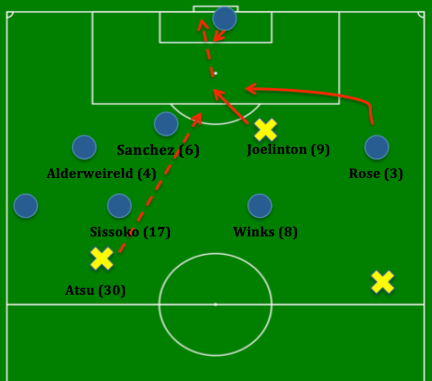
In the build-up to the goal, Tottenham had six outfield defenders behind the ball to Newcastle’s three attackers – six versus three.
Joelinton is positioned in the Spurs defensive backline. The question is, from a defensive point of view, whose ‘zone’ is he in? He is Newcastle’s main striker. The next nearest Newcastle forward is the passer of the ball, Atsu. One would expect that the responsibility for the marking of Joelinton must lie with one of the Spurs centre- backs. Spurs defensive line is flat – three players in a straight line.
It would make sense, before the game even starts, that one of the two centre backs will assume responsibility for the marking of the opposition striker. They may inter-change the role during the course of the game but one of them ought to be marking the centre forward at all times. In this case it seemed neither were even thinking about man-to-man marking of the centre forward.
Sanchez, even if he was close and alongside the forward, it is doubtful he would have been able to stop Joelinton’s run. The reason being he would not be goal side. In this situation, the defender has to forget about playing offside or holding a defensive line. He needs to drop-off and have the Newcastle forward, as well as the ball, in his sights. By dropping off, he is actually taking up a position in the path where the forward is looking to run. Adopting such a position is likely to discourage the ball being played in in the first place. Yes, you are abandoning the defensive line. This has to be an inevitable consequence if you want to ensure opposition players are marked. If the Newcastle forward wanted to follow Sanchez into the box, the defender will still have a goal side position. Whether the eventual ball is played in to the near post or far post, there is the opportunity to contest the ball.
The through ball was played into space and Joelinton, completely unmarked, one touch to control and second touch to score. Rose could possibly have recognised the poor positioning of his centre back and provided some sort of cover of his own. There was nobody on his side of the field to warrant attention. Sissoko was only providing passive pressure on the provider of the pass, the killer-pass from Atso, which suggests he needed to be tighter on his marker. Tottenham fans may recall the conceding of a similar goal in the first leg of the Champions League semi final that allowed Donny van de Beek to move between the static zonal backline of the Spurs defence.
Positional play, knowing when to hold the line and when to abandon it is a key element of playing zonal defence. Zonal defending is asking a defender to operate in a shape-shifting space. Having the instincts of knowing when, precisely when, to switch from a zonal format where one is potentially marking space to a man-to man format, where one takes personal responsibility for the marking of an opponent, only comes from understanding and playing man-to-man defence. This is a problem if you are only use to playing zonal defence.
The football pundits seem incapable of analysing defensive play in any terms other than through the zonal format. They will talk about the ‘two banks of four’ and trying to close the space; the playing ‘between the lines’, the ‘straight defensive line’ that has to stay intact no matter what. The post mortem can invariably find the culprit who was not marking his man.
It would suggest that this process of marking does not seem to happen naturally within the zonal format. Often, it doesn’t happen at all. Why is that? The sheer frequency of opponents getting free and not getting picked up suggests the fault lies with the system or the players’ interpretation of the system.
You may say, I am also guilty of identifying the roles of particular players and stating what their role should have been after a goal has been scored. The difference is that I am framing solutions within a different system of defence, the man-to-man defensive system. Perhaps I should not refer to it as that. It is too confusing. It is misinterpreted and dragged down by the more common term of ‘man marking’. Why not just think of it in terms of marking opposition players, particularly when they have or are likely to receive the ball in dangerous areas. Put simply, when does a defender switch from guarding space to marking an opponent? This is football’s defensive conundrum.
 No offence intended