“You’ve got to be unpredictable” — Jun 8, 2019

“You’ve got to be unpredictable”

Uefa  Nations League semi final:


Netherlands 3 England 1 aet    6 June 2019


The quote is from Jim Courier in relation to tennis players.   But this simple phrase equally applies to any sport.


In the post match analysis:


Jamie Carragher was supportive of John Stones who, as the last man, was dispossessed of the ball that led to Holland’s vital second goal in extra time.   His stance being that he would rather be playing out from the back than hitting the ball long.


Jamie Redknapp commented that all teams are playing out from the back now so England have to do it.


Gary Neville thought that coaches in this country, and he included himself in this regard, are not good at coaching “rotation” in midfield.   By this he meant, midfield players making themselves available to receive the ball from the backline player.


Ideally, the favoured approach for any team ought to be one of possession.   This means short passes as opposed to long ones.   The long pass, particularly when playing out from the back, is often a desperation measure played by the goalkeeper who acts as a safety valve in the possession-style football.


The only attraction of the long ball out from the back is that it represents safety.   Get the ball away from your own goal and avoid the risk of losing possession in front of one’s own goal.


The nature of the risk was plain for all to see when John Stones lost possession and the ball was duly despatched into the goal.   The third goal was also as a result of trying to play out from the back.


There is another factor at play here.   It is the unbridled, firmness of intention to play football in this way.   This sends a clear message to the opposition and enables them to exert even more pressure on the team playing out from the back.   Put simply, the style of football is predictable.   The Dutch duly responded by pressing England high up the pitch early on.


In order for teams to exert more pressure they have to commit more players forward.   Thus, potentially, there is more space to exploit for the team playing out from the back in behind the pressing players.


Rather than playing copycat football when the threshold for success is set so high and a relatively simple mistake can have such dire consequences in the outcome of the match, there is a case for a more proportional approach.


Chris Sutton, the ex-professional footballer and pundit is of the view that John Stones’ error was nothing to do with playing out from the back.   It was all to with decision-making.


Uh ha.   Everything a sports person does is to do with decision-making.   He had choices; he could have kicked the ball off but that wouldn’t have really been acceptable.   The most obvious pass was to play the way he was facing and pass back to the goalkeeper.  But he had clearly not selected this option.   What was he thinking?


An alternative plan


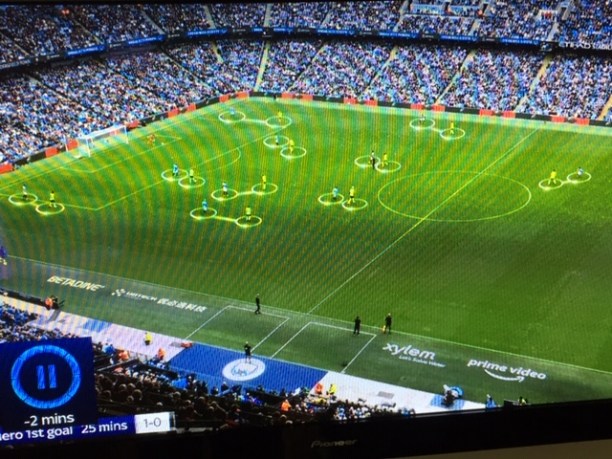
Leicester City under Brendan Rodgers seemed to strike a good balance between trying to play out from the back and not take any undue risks.   In the Monday night football game away to Manchester City, 6 May 2019, that City won 1-0 after a Vincent Kompany wonder strike, they had a clear plan.


Kasper Schmeichel was used frequently as a safety outlet but instead of him hitting the ball long down the middle, there were options provided by wide players on either side of the pitch for the goalkeeper to pass the ball to.


If the wide player is able to control the pass from the goalkeeper the possession-style football can continue to work its way forward.   But, if the player on the touchline loses possession, it is not in an area of the pitch that presents an immediate threat.    There is a chance for the team to re-group.


Better still, losing possession could be immediately countered with a rapid press of one’s own.  The ability to turnover the ball quickly after losing it – a tactic long used by Jurgen Klopp may provide the option to continue the attack.


Ajax are playing man-to-man — May 10, 2019

Ajax are playing man-to-man

Ajax 2 Tottenham 3   Champions League semi final 2ndleg 8 May 2019


Despite Tottenham conceding early on in this second leg Champions League semi final game, just five minutes and then again before half-time to go in 2-0 down on the night, 3-0 on aggregate, most people thought that this must be curtains for Tottenham.   Ajax, playing a man-to-man defensive system, could not stop the Spurs’ juggernaut.


Second half, up stepped Lucas Moura.  Tottenham’s first one, on fifty-five minutes, following up Alli’s effort gave Spurs just a flicker of light that this is possible.   The second goal arrived just four minutes later from the same talisman and now Spurs enjoyed the momentum Liverpool had the previous night.


The score was 2-2 on the night, 3-2 to Ajax on aggregate but there was still thirty minutes of the game to go.   Tottenham just had to score one more goal and not concede any to get themselves into the Champions league final on the away goals rule.


Ajax thundered one shot against the post in the closing minutes and then ninety minutes were up, neither team able to find that elusive goal to seal the tie.   Five minutes of additional time was announced and with four minutes and fifty seconds of this time elapsed, unbelievably, Lucas Moura again, wriggled his way in the box to score his third on the night.


This was showtime as you have never experienced it before.   The comeback, the drama was electrifying.


Team man-to-man defence in action


From a technical perspective, this was the first time I have seen a team playing a team man-to-man defensive shape.   The second time actually as this was how they played in the first leg.   I wanted to double check that this was, in fact, their defensive style.


I must stress this is not the man-to-man defence commonly associated with football: the man-marking variety of one player from the opposition being singled out for special attention.   No, this is the team man-to-man brand that I have been painstakingly trying to explain in this blog.   And here it was, in action.


It is difficult to grasp exactly how Ajax set their defence out.   Barney Ronay, the Guardian football correspondent, aptly described it as:


“They lined up here as expected, arranged in the usual roving, indefinable formation, something that should probably go down on paper as 4-something-could be 2-Ajax-stuff-fluid-here-Tadic”.


He suggests that Ajax seem to be “refusing to play by any standard footballing rules of structure and movement”.

In the first leg it was noted by Edgar Davids how efficient Ajax were at pressurising the player on the ball while Tottenham didn’t appear able to do the same to them.   It was also evident that when Spurs did have a player on the ball in a threatening position, there was not just one, but two, and sometimes three Ajax players around him.


These are the hallmarks of a team man-to-man defence.   Players do not necessarily conform to set zonal positions.   You have watched the game but you may not have recognised the defensive model.   It is different but not so different to be obvious.


Ajax’s attacking shape, particularly in the first leg, was also sublime.   The second goal in the home tie made Tottenham’s zonal shape look quite ragged.  Once again, a quick exchange of passes soon found Ziyech completely unmarked to fire home and make the score 2-0 on the night,   (Tadic providing the assist!).


You may recall Ajax’s goal in the first leg that allowed Donny van de Beek to move between the static, zonal backline of the Tottenham defence to receive the killer pass.   He then had all the time in the world to pick out the bottom corner.


The subtleties of precise player positions together with the need to take account of opposition players, is the combined effect of playing a team man-to-man defence.   However, no system of defence is impregnable and it makes Tottenham’s comeback in this game all the Moura remarkable!

What’s basketball got to do with it? — Apr 18, 2019

What’s basketball got to do with it?

photo-1484482340112-e1e2682b4856

Goal-side comparison

There is a general acceptance that being goal-side is important in football and the zonal shape is testimony to the need for players to get behind the ball as a collective unit.  However, embedded in this zonal shape is the secondary objective, which is to play the offside trap.   So all zonal shapes will have a flat backline.   This is significant as the nature of a flat back line effectively abandons the principle of goal side in the most crucial part of the field, which is in front of goal.   This means any opposing forward can position themselves alongside the defenders in the backline.   Worst still, the attacker is facing the goal and the defender has their back to it.

This type of defensive strategy is purely in the name of playing the offside trap.   It is quite astonishing that the whole of football, without any exceptions, choose to base their entire defensive policy around the offside trap.   This forced inability for defenders in the backline of defence to apply good defensive technique, the first principle of which is being goal-side, then permeates other aspects of their defensive play where the playing of offside may not be a factor (see blog: Being goal-side).

This mentality extends to all parts of the team.   For players who are not in the backline of defence, they know that there is always someone else to cover for them so their commitment to retaining a goal-side position isn’t always convincing.   This manifests itself in players going to ground trying to win the ball or simply not tracking a player.   This highlights the importance of individual responsibility when it comes to defending.

All this is further exacerbated by the zonal system that does not clearly match player against opposition player.   The matching process instigates pride for the defender in doing a good job on their respective marker.   The individual defender comes to own the process.   This is one advantage of playing a man-to-man defensive system.  Each player knows their exact task and is accountable for their opposite number.   This is also helpful for the coach who can see which players are making errors consistently.

The real problem with zonal defending is one of ownership.   The players themselves don’t always know, in advance, who is responsible for marking a particular opponent before they get the ball.   Time and again offensive players are getting free because there has not been an allocation of marking responsibility.   This is the problem.   This is how it is.

It is difficult to underestimate the importance of individual defence.   The only way I can convey the significance of maintaining a goal-side position on one’s opponent is by looking at the emphasis placed on this aspect of the game in another sport, the sport of basketball.

athlete-ball-basketball-163423

Defence in basketball

The general principles of playing defence are the same for both sports.   It is true that in basketball the ball is played with the hands as opposed to the feet and there are some minor differences in defensive technique with regard to this but the stock-in-trade one-versus-one scenarios are virtually identical.

The essence of defending in basketball is for the defender to stay between the player you are marking and the basket.   There is a particularly good reason for this in basketball, as the defence will have the rebounding advantage when a shot goes up.   The inside position allows the defender to box-out his marker’s route to the basket.   If the defence secure the ball they will be looking to fast-break.

It is a commonly accepted principle in basketball that the player with the ball has the initiative.  The offensive player makes the moves and the defender has to react to them.   This is the same in football.   The odds are stacked against the defender in any one-versus-one situation.  The team man-to-man defensive system attempts to avoid this isolation by providing support to the player defending the ball.   This is what really distinguishes team man-to-man from the more familiar term in football of ‘man-marking’.

A typical defensive position for a defender in basketball is to be semi-crouched with one foot slightly in front of the other, weight on the balls of the feet and evenly distributed.  The emphasis is on trying to maintain a basket-side position.   It is not necessarily to try to win the ball.   Occasionally, this may be possible but it is not the objective.  This is where the principles of defending in basketball maybe in complete contrast to football.

The basketball player has to learn how to move about the court and the technique for this could be considered ungainly.   With their feet shoulder-width apart and adopting a virtual sitting-down position the defender is able to make quick, shuffling movements and thereby stay in touch with the sudden movement of an opponent.   In order to shuffle quickly it is vital to be in a low position.   This movement is an anathema to most footballers.   One player who has had some experience is John Terry who has commented, in a fairly suspicious tone, of the crab-like movements.  The point is, it gets the job done.

animal-crab-creature-76966

Basketball teams will devote significant parts of a training session to defence.   Drills in defensive stance and moving in this position form part of every session.   The defender needs to be able to move as quickly as the attacking player in order to maintain a basket-side position.   This is the golden rule.   Always stay between your marker and the basket.

Maintaining a basket-side position enables the defender to try and force the attacker either towards the sidelines or towards a fellow defender.   Most players have particular characteristics in their play, which, as defenders, it is important to weigh up.   These can vary from a particular type of dummy, for example in football a step-over, to a particular side a player likes to go that will favour either their left or right foot in the case of football.

Being goal-side enables the defender to try to edge the attacker towards their unfavoured side.  Of course, the attacking player still has the irritating presence of the defender to contend with.   This is where the team man-to-man comes into its own when the assistance from another defender is available.

The whole business of learning to master defensive technique is best done through the playing of man-to-man defence.   The reason for this is the clarity provided by knowing the identity of the person you are to be responsible for.   This enables the defender to plan in advance their movement and body position before their marker even receives the ball.   In so doing, the defender can be marking their opponent as they receive the ball, rather than once they have gained control of it.   There can be immediate pressure on the ball.   The body language is much more tigerish.   It’s not an amble towards the ball once the player has gained control of it.   A whole new level of intensity ensues.

It is far more difficult to achieve these objectives with zonal defending due to the fact that there is no obvious matching of defender with opponent.   A matching process will occur but usually only after the opponent has received the ball.   Defenders in football can easily find themselves marking different opponents during one phase of play.

The zone defence in basketball is more manageable mainly because of the smaller area and fewer players to organise.   Even so, there is a ‘passing-over’ process where the defenders will have to assume responsibility for the marking of a particular player and then pass this responsibility to a teammate if this same player moves to another part of the zone.  Defensive players are therefore constantly talking to one another and making sure that the opposition player in possession of the ball is being marked and is accounted for by a particular defender.

Playing zone defence in football

In football, this ‘passing-over’ process is virtually impossible to implement.   A forward can move through zones within the defensive format so quickly that if the ball arrives in a particular part of, say, the penalty box there is a good chance that they will not be marked and the identity of the defender that should have been marking the forward is also likely to be unknown at that point.

Add to this the constraint of trying to play for offside and the restrictions this imposes regarding the movement of defenders all makes the defender’s job a particularly difficult one.  This is why, despite all the best intentions, opposition players invariably find themselves unmarked, but not only in front of goal in the midfield areas as well.    These are quite often the players providing the killer assist.

The playing of offside and the zonal system of defence compliment each other perfectly in football.  But, in playing with a flat backline you are effectively placing more trust in the officials and their ability to make the correct decisions according to the laws of the game than you are in your own players’ defensive technique.

Basics of defending

If you think about the purpose of any defensive strategy, its primary objective is not to concede goals.  To have the best chance of achieving this, opposition players ought to be marked, as far as possible.   The question, therefore, is which system best delivers on the marking of opponents?

An analysis of Premier League goals scored in the first week of the season revealed that some 64% of goals were conceded where players were completely unmarked (see blog dated Nov. 6 2018).   This figure is not a one-off.   A similar survey carried out on the first week’s games in the 2015-16 season was 67%.  These are high percentages for goals to be conceded in this way.   They are certainly high enough to provoke thought and discussion.

Is it time to start thinking about things in a different way?

The attacking advantages of playing man-to-man defence — Mar 12, 2019

The attacking advantages of playing man-to-man defence

Coaches all around the world are constantly grappling with formations to identify pockets of space that they can exploit when in possession of the ball.   The most classic of these is the counter-attack that attempts to get the ball forward quickly before the defence have time to organise.   This is a format that ought to be considered as a priority option for any team.


In this blog, I have identified many of the strategies that teams utilise when, and if, the counter-attack is not viable.   These range from playing between the lines, that is the space between midfield and the back four or between vertical lines, between centre back and full back.  There is also the freeing up of space by utilising the switch ball on either side of the pitch as described in the ‘2-7-2’ formation.


All these tactics are based on playing against zonal formations.   If you play a ‘team’ man-to-man defensive formation it rather scuppers all these well-laid plans.   And, it is not that difficult to do.   The supposed spaces that are deemed fertile areas for getting free, no longer exist.   Yes, players would need to get use to the different type of format.   In some ways it is not massively different to playing zonally.   However, there are a few subtle differences.


IMG_1753


Full court man-to-man press


In the example above, the opposition are lined up in a strict full court man-to-man marking format.  Because it is a dead ball situation it is relatively easy to implement.   The problem is that because it is a goal kick the opposition cannot apply any pressure to the ball, namely the goalkeeper.   This allows the goalkeeper to kick the ball long, bypassing the press, and leaving a potentially dangerous one-versus-one situation at the back.

This type of full court man-to-man press really ought to be implemented during open play where it is possible to pressurise the goalkeeper.   With any full court press the players are isolated and it is difficult to provide support to teammates.   But, man-to-man marking does not always have to conform to full court.   A more sustainable model would be to play half court.  Here, it is open play and the defending team have only to cover half of the area and this enables them to be more compact.   The compactness allows them to provide support to one another.


 Understanding man-to-man


The only reason why this type of defensive organisation has never really caught on is the fundamental misperception of confusing this team approach to man-to-man marking with the more familiar term ‘man-marking’.   The major difference between the two is that the latter is an individual approach to marking opponents as opposed to a team approach.   How this manifests itself is in the area of involvement where the player one is marking, is not in possession of the ball.    ‘Man-marking’ has the reputation of sticking to your marker no matter what – even going to the toilet with them!


This type of approach does not work and has rightly been referred to as a fools’ game.   The emphasis with the team approach to man-to-man is primarily with the opponent on the ball.   There will be one player responsible for marking this opponent but other teammates all have a responsibility to support the player marking the opponent on the ball.   Obviously, the defenders closest to the action will play a more prominent role.  Ideally, looking to get at least two players to defend against the ball particularly when the play gets closer to one’s own goal.


In this respect, there is a zonal element to man-to-man marking.   The idea is not to isolate any one defender in a one-versus-one situation.  As soon as you can get a second defender in place, this changes the whole landscape and puts the defence in control as opposed to the individual attacker.   At least, in theory it should do but there is some defensive technique to implement before the control element can be regarded as a given.


It is not feasible to mark all ten out field players.   It is not necessary.   However, it is necessary to make sure all the main providers and penalty box threats are marked.   There ought to be one player at the back who is not responsible for marking any particular player and is there to sense danger and provide support where necessary.


There is another way of creating space

By the nature of the defensive formation with the team defending in a man-to-man style and largely now in their defensive third, the players from both teams are going to be more evenly distributed around the playing area.


From an attacking point of view, players are trying to find space in areas away from the ball whilst others are may be looking for a short pass option.   With man-to-man, once you get a turnover it’s absolutely the best time to attack.   The player, having just won the ball back, will have space to move in to as the player whom he was marking is going to be momentarily out of the action.   This enables the player to drive at the defence and create opportunities for other players breaking forward.


Whilst this is a counter-attacking play, it is not like the usual one that originates from deep in defence.   This could easily be initiated from a mid-field area and so the attacking advantage is potentially clinical.


The beauty of this attacking style is the fact that it is initiated from your own style of defence.  In this respect, it is unlike all other strategies of finding space to exploit that rely on the opposition playing a form of zonal defence.


He’s behind you — Feb 19, 2019

He’s behind you

The dilemma facing defenders is whether to hold the line or get goal side of your opponent.   When an attacker gets goal side of the defender, it is self-evident to suggest that the defender should have been goal side, particularly if the resulting outcome is a goal.   Given the frequency with which this happens it is worth understanding the circumstances that contribute to these defensive failings.


With zonal defending, there are a number of factors going through the mind of a defender when the opposition are attacking.   These could range from holding one’s position or whether to go towards the player on the ball.   If one goes towards the ball, the concern is who is going to fill the gap that is left?


It is important to maintain the defensive line, particularly around the penalty box, because if just one of the line drop back towards the goal it could impact the offside trap.  And yet, dropping back towards the goal is likely to be the movement you are asking the defender to do when you want them to be goal side.


The decision to be goal side inevitably leads to abandoning the defensive line.   Is this a group decision or an individual one?   At what stage in the defending process should this occur?   If the defensive line is being abandoned and the criticism is that a certain defender should have been marking a particular attacker, the goal scorer, what should the other defenders be doing?


Presumably, they should also be marking attackers as, before the ball comes in say from a cross, who knows where it is going to arrive?   This begs the question of who is supposed to be marking each one of the main protagonists?  There has to be a coordinated effort so as not to leave one person out.   Invariably, there is one attacker in or around the box who is completely unmarked and the ball falls to them.   Defenders are in the vicinity and may or may not have seen this player as a potential threat but nobody has assumed responsibility for the marking of this player.  As the ball arrives it is too late to do anything about it.


Going man-to-man


A good way for the defence to solve this problem is to match-up in a man-to-man style with the opposing attackers.   But when do you do this?   Who’s going to organise it?   If one person has been left unmarked, that would suggest the organiser is not doing their job properly.   Is there an organiser?


There needs to be an organiser so that each defender is allotted someone to mark on the basis of proximity but also in the knowledge that every attacker is accounted for.  As we have seen, you cannot afford to miss one out.


The abandoning of the defensive line, the straight line of defenders that is the cornerstone of every football team’s defensive strategy as though it were stated in international law, is a big deal.   The whole defensive structure of the team is based around this and we’re not sure if it is an individual or a team decision to make this call.   One thing is clear.   If the call is not made, the defenders will not be goal side.


Which matters more?


Don’t forget, the moment a centre forward stands in the straight defensive line, alongside one of the opposing centre-backs, none of these defenders will be goal side on this particular opponent.   In order to be, they have to step back a few steps so the attacking player is in front of them rather than alongside.   But in stepping back, the same forward can also step forward to reinstate the position alongside the last man in defence.


The defensive line either has to keep retreating towards its own goal or it maintains its line, high or low line, and in doing so these players are not goal side.   So, the simple statement of saying that a particular defender should have been goal side is a bit more complicated than it first seems.


The basic principle of any defensive system is to prevent goals being conceded.    A basic principle of individual defensive technique is to be goal side on one’s opponent.   If we take the scenario where a goal is actually conceded and the post-mortem that prevails identify how this situation could have been avoided and specifically the role of various defenders.   In those situations where the goal scorer is clearly not being marked, questions will inevitably arise.   Of course, there is an expectation that the goal scorer should have been marked.   In other words, the defender should have been goal side.


Marking space or players


This implies that a defender should, at least, have been matched up against this attacking player.  The matching-up process is akin to a man-to-man defensive set up.   Ultimately, in any defensive system, defending will come down to one defender matching up against one attacker.   Thus, we should not be fazed by the concept of man-to-man marking.   It ought to be regarded as a natural part of any defensive system.


Zonal marking


Even with zonal marking, in the final analysis, the opponent on the ball has to be marked.   The nature of zonal marking, as opposed to man-to-man marking, means that the identity of the defender who one should be matching up against is not always clear.   It will come down to an allocation process whereby someone in the defensive unit, probably a centre-back, will take charge of allocating defensive responsibility to all fellow defenders.


This is where the ambiguity begins.   The allocation of marking responsibility will take a certain amount of time.   If this process hasn’t been completed before, say a cross comes into the penalty box there will not be sufficient time to make this allocation while the ball is in flight.   Defenders need to know, in advance, who they are responsible for.


With man-to-man, whilst you will start out in a zonal shape, the process of allocating marking responsibility starts much earlier and so by the time the play gets around one’s own box, the identity of who each defender is responsible for has been established.


Fulham 1 Tottenham 2  Premier League 20thJanuary 2019


Fernando Llorente, replacement for Harry Kane, opened the scoring for Fulham with an own goal!


Spurs goals:


The first was a delivery by Christian Eriksen from just outside the right corner area of the box to Deli Ali with a free header at the far post.   There was no pressure on the ball so Eriksen was able to look up and pick out his pass.   No marking of Ali either.   The full back could have tucked in and possibly provide some resistance, but didn’t.  Why?   Is it a lack of concentration or is it to do with the zonal shape?


The pundits, Jamie Redknapp and Graeme Souness claim that the defender needs to be goal side.  Yes, but as we have seen being goal side would require them to abandon the defensive line.   The confusion for the full back is, knowing when to make this decision.   The decision is also, effectively, taking responsibility for the marking of a particular opponent.


With hindsight it is all so obvious.   But, if this one defender does take responsibility for this one offensive player (Ali), should the other defenders also be taking responsibility for other attacking players?


There should be a team strategy to ensure that all the main attacking threats are accounted for.  This entails not just one player but several players taking responsibility for the marking of opponents.  The implication of this is that the defensive line, the zonal defensive line, is abandoned in favour of matching up with opponents in a man-to-man defensive organisation.


In situations where crosses are being played into the box, it seems reasonable to ask what is the point of a defensive line?   It is the same point as before: to keep the opponents on side.   But now they are just one touch away from scoring and the defender is not in a good position to do anything about it.


It is quite plain to see, from the closed body position of the defenders as opposed to an opened-out one, that the backline is still intent on upholding the defensive line, a feature that is completely consistent with the zonal shape mentality.   When a cross comes in, generally the defenders are looking at the ball with possibly the occasional glance over the shoulder to see who is behind.


Unfortunately, this is not the best technique for defending against an opponent.   The defender needs to be opened out in such a way to be able to see both the ball and the player they are marking.   To do this, one has to move back a few yards, adopting a goal side position, in order to utilise one’s peripheral vision.   This way they are able to anticipate the movement of the forward and this means they can then contest the forward’s movement.   In layman’s terms, get in their way.


In the case of Ali’s goal, notwithstanding the limitation of defensive technique, the decision to drop and abandon the defensive line was taken too late, if at all.


In reality, the individual defender doesn’t even know the identity of the player they should be marking as the cross comes in.   It all happens so quickly.   These are the details that can so easily be overlooked when post-match analysis ensues.


The second goal, right at the death, was a carbon copy of the first as far as the defensive frailties are concerned.   Only this time the cross came in from the other side of the pitch and Harry Winks ghosted in to head home from about two metres.   The left full back for Fulham on this occasion was criticised for not being goal side.   No pressure on the cross coming in.   The goal scorer was not being marked.


Another example.   The day before:


Wolves 4 Leicester 3 Premier League 19thJanuary 2019


Wolves opened the scoring inside four minutes when Jota arriving at the back post was hungrier than Danny Simpson, the Leicester right back and was able to just get his foot ahead of the defender to stab home.   The same defensive errors prevail.


This is a recurring theme and the basis of this dilemma is the zonal shape.



2-7-2 Formation — Feb 3, 2019

2-7-2 Formation

This is the brainchild of PSG’s under-19 coach Thiago Motta.


The 2-7-2 formation is really a description of a regular 4-3-3 but instead of reading from back to front of the pitch, it is read from side to side and includes the goalkeeper.  Note, the numbers add up to eleven, not ten.


From an attacking perspective, the focus is on the two on each side of the pitch away from the ball who will be able to find space.   See link below for full explanation.


Finding space


It is assumed attacking players can naturally find space by positioning themselves away from the zonal markers.   The concept of ‘playing between the lines’ of zonal formations, either horizontal lines between the back four and midfield or vertical lines, between centre-back and full back have been discussed in previous postings.   Here, the battle to find space is on either side of the pitch.


Many of these strategies about finding space often prove to be successful.   There is space in these various areas for attacking teams to exploit.  But, in all cases, it presupposes that you are playing against a zonal shape.


The reality is that teams are playing against a zonal shape.   So, this is not a problem unless you change the zonal shape to a man-to-man shape.


The Inefficiency of the zonal shape


In order for the attacking team to have a player free in any of these spaces implies there is inefficiency in the defensive zonal shape.    The attacking team have the same number of players and in order for one of them to get free would suggest that the defending team have an over-supply of players somewhere else, usually in their backline.   Therefore, there is an under-supply of players in the midfield area, hence the free player.   This is the nature of the inefficiency.


Any defensive system will have its weaknesses but it ought to be able to ensure, as far as possible, that opposition players are being marked.   Preferably, as they receive the ball as opposed to after they have received the ball.   There is a relaxation of this principle in football, possibly due to the size of the pitch and the number of players involved.   It may also be to do with the communication and organisation of the zonal shape.


The team man-to-man system


The man-to-man system has a better chance of delivering on this principle.   However, this is not necessarily the man-marking system that the football fraternity are accustomed to.   The team man-to-man system prioritises the marking of opposition players.  This assists the individual defender to mark an opponent “as they receive the ball” which brings a whole new level of intensity to the proceedings.   It is particularly important for pressure to be applied to the opponent in possession of the ball, not just around the box but in midfield areas as well.   The defender marking the player in possession of the ball may also require assistance from teammates.   This is where the ‘team’ element comes in.


The priority for the defending team is the opponent on the ball.   Other defensive colleagues should try to provide support to the player marking the opponent in possession.   The level of support will be determined by the proximity of those defensive colleagues to the ball.   In all cases, defending players who are not directly marking the opponent on the ball should move towards the ball.   This means moving away from your own defensive marker.   However, the distance one moves away must be commensurate with being able to be back in contact with this marker in the time it takes for the ball to arrive.


It is this distinction that enables, for example, a wide midfield player marking there opposite number (an attacking wide midfield player) to be able to “sag” or move across the pitch towards the ball as the opposition attack down the other flank.  But, they must also be able to travel back towards their marker and be there in the time it takes for the ball to get there.   It is possible that this particular player may be able to travel as far as the middle of the pitch.   Significantly, they would be back in touch with their marker if the ball were to be played out to this wide midfield area.


In terms of the 2-7-2 formation, this type of defensive organisation negates the opportunity for attacking players to find themselves free in space.   The same principle would apply to other zonal formations looking to exploit space in other areas of the pitch.


The man-to-man system of defence not only ensures that opponents are not left free in space but, at its heart, is the core principle of providing pressure on the attacking player in possession of the ball.   Thus the opportunity for this player to even make the relevant pass to any prospective player, in space, is greatly reduced.   This means that the initial distribution of players in the defensive zonal shape with a predominance of personnel in the backline is less important.  However, it would be appropriate to leave one player free from individual marking responsibility in the defensive unit.   It is quite feasible to facilitate this luxury.


Consolidation in shape


The principle whereby all players try to provide support to the player marking the opponent on the ball provides a consolidated shape around the ball.   Obviously, this shape is adjusting all the time according to the position of the ball.   Whilst it is a different kind of defensive shape it compares favourably with the zonal defensive shape where the principle of consolidation and, ironically, being ‘goal side’ are at the heart of this defensive shape.


Two different shapes


There is a broader point here, which is worth keeping in mind; the man-to-man defensive structure, is a strategy that is completely different in kind to the zonal format.  This fact alone ought not be underestimated.


It is difficult to understand how football just has this one playing system, a zonal system, with largely the same playing formation that is supposed to deliver for both attacking and defensive purposes.   These two elements of the game are completely different.   They are tactical opposites.   Being in possession allows the team to dictate play and the opponent has to respond to this play.   It does not make sense for one model to meet these opposing objectives.


At least with a man-to-man defensive structure, that addresses and is able to respond to any demands placed on it, you may want to adopt a zonal shape to address the attacking priorities.


Football needs to reform its defensive model.

Case study: Hockey — Jan 15, 2019

Case study: Hockey

Have you ever watched a game of hockey?

Structure

Team sports have more in common than you think.   Hockey, for example, has a very similar structure to football; the size of the playing area and goals although smaller, are similar.   There are eleven players on each side and, up until the mid-nineties hockey had an identical offside rule.

The sport, which is now played on astro turf, also adopted many of the same playing positions which originate from the old W-M formation, before 4-3-3 emerged in the sixties and then 4-4-2.

Watching hockey, one of the first impressions you might gain is the sheer pace and tempo at which the game is played.   Following the abolition of the off-side rule, a new way of playing has emerged where the holding of a flat backline is no longer relevant.   Much greater emphasis is placed on assuming a goal-side position on one’s opponent and, this principle, is adopted by all players in the defensive unit.

Hockey teams still adopt an initial zonal shape when it comes to defending to ensure coverage of the playing area.   However, this will often develop into a man-to-man format as play gets closer to one’s own goal.


field-2023250_640

tmp826155487136317442

Not all pitches are the same size in football, though the preferred size for many professional teams’ stadiums is 105 x 68m (115 x 74yd).

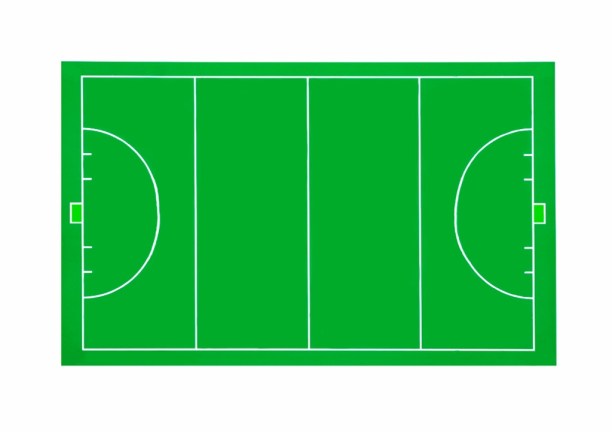
Hockey pitches tend to be of a standard size 91.4 x 55m (100 x 60yd).


The off-side rule and football

This could be of interest to football as playing in a zonal shape with a flat backline is considered the ‘holy grail’ in football and there is barely a team, at any level, that does not set up in this way.   The idea of possibly setting up in another way is regarded as a complete anathema to most people.

The prospect of playing man-to-man defence in open play has never really been embraced by football as it straddles that line between exciting and scary.

Myth

Perhaps the biggest mis-perception in football is that man-to-man marking is not possible.   It is difficult to understand why there is such vehement opposition to this given that football will naturally opt to play a man-to-man strategy when defending at corners.   Why not in open play?

We’re not talking about Ron-chopper Harris and man-marking seventies style.   The number of goals being conceded as a direct result of either the player scoring the goal or the player providing the assist not being marked, suggest we may need a new model.

You don’t have to defend in lines, which seems to be the natural outcome of zonal defending.  Rather than allowing opposition forwards to play between the lines we need to read between the lines and recognise that there is a fundamental insecurity in the lines of communication between defenders trying to organise their defence.   With zonal defending, everyone seems to operate in their own distinct bubble of time and space.   Man-to-man marking makes you more accountable.

With man-to man marking, it is difficult to evade responsibility.   It is the element of accountability that encourages understanding and, in turn, the true glories of the art of defending.

Best of both worlds

There is no prospect of football doing away with their off-side rules.   This is not being advocated.   Rather, football can enjoy the best of both worlds.   They can carry on adopting the tactic of playing as they do in a zonal shape with a flat backline, catching out opponents from time to time with the off-side trap.   Or, they could abandon the flat back line in favour of a man-to-man defensive strategy.

The playing of off-side feels very familiar but it is fallible.   It can be very productive and yet, because the whole defensive shape is based around this tactic, it can also be very constrictive.   It may be responsible for not just the conceding of goals but factors relating to basic technique.   Regardless of what defensive shape you choose to adopt, defence will always come down to the one-versus-one, the individual technique.

The way opposing attackers keep cropping up in the penalty area completely unmarked at least ought to lend credence to the idea that an alternative model of defending may be worth further scrutiny.

In a team man-to-man defence, an individual defender can still invoke the off-side rule by making a unilateral decision to step-up and leave the opponent in an offside position if the situation presents itself.

Less predictable

Playing different systems in one game is potentially a game-changer.   The offensive pattern currently is pre-disposed to match up against a zonal defence.   The introduction of a man-to-man defensive shape, throws this attacking strategy out of the window.

It doesn’t have to be all one thing or another.   Once players become familiar with a man-to-man strategy it is relatively easy to flip between the two.

Some will argue that by not playing a zonal defence you are relinquishing the ability to compress the play.   This is best done at source.   Providing pressure on the ball is the defining principle of man-to-man.  Without this, compression of play in terms of a team shape is almost pointless.


Springboard to attack

In hockey, players will often be matched up with their opposing number in man-to-man marking particularly in their defensive third of the pitch.   If the ball happens to be stolen back whilst in this format, it is apparent there is an immediate area of space for the newly won ball carrier to travel in to.   The player who has just lost the ball is temporarily out of the game.

In control

Confidence is king when defending.   Making players take responsibility for their decisions (with man-to-man marking they are accountable) instils self-belief.   Being able, and confident, to invite teams on to attack you is sometimes a necessary part of the strategy to be able to attack them.   Obviously, there is more space in which to launch a counter-attack.  The counter-attack should be every team’s first option when attacking.


Man-to-man in open play

The modern fixation of “playing out from the back” has brought about the counter tactic of pressing.  This type of press, unlike the gegenpress,which is utilised to win the ball back immediately possession is lost rather than falling back to regroup, is often utilised as a full-pitch man-to-man defensive strategy.   This is a high-energy tactic and it is a clear example of team’s applying man-to-man principles in open play.

So, it can be done.


We are not defenceless — Dec 5, 2018

We are not defenceless

This is a critique of zonal defending.   Pep Guardiola makes the case for zonal defending in his book ‘Pep Confidential.’


“Zonal defending is much more effective than man-marking.   It’s so much simpler for a player to stick to his zone.   He knows he’s responsible for that area and that sense of individual responsibility then becomes collective responsibility and in turn strengthens team solidarity.”


The main purpose is to not just stand in the zone but to actively mark opposition players as they enter the zone.   The zones are not clearly defined.   Players are responsible for defending a zone, which, in practice, means they need to match up against opposition players as they enter their zone.   Effectively, defending one-against-one with that opponent.  Zonal defending, therefore, consists of man-to-man principles of defence.   The two main forms of defence are not completely distinct from one another.


Between the lines


It is a common tactic for attacking teams to find space ‘between the lines’.   These lines are usually horizontal lines, between the back four and midfield, where opponents are often able to receive the ball in space.   In theory, such spaces shouldn’t exist.  But, exist they apparently do.  The reason for this will become clear.


It would suggest that at least one defending player who is comfortable in their currently allotted zone but not marking anybody, may have to leave this zone to mark the opponent who has found space in another zone.   Even if they are already marking someone, the responsibility for this may have to be handed to a teammate.


This is where playing in a zonal defence can start to get a little complicated.   The reality is you may be in a zone with no opposition players to mark.   You may have more than one opposition player in your zone.   What happens when an opposition player passes through your zone into another zone?   Is responsibility for the marking of this player transferred?


The issue about when a defender should go to the player on the ball and when to hold the space is a recurring theme in zonal defending.   The concern for defenders, particularly those in the backline is, if they move out of their zone to contest the ball, who is going to cover their zone?    If nobody covers, a gap appears.   Defensive cover is crucial.   If the defence is well organised the player moving out to contest the ball should be actively encouraged to do so by a teammate who has already read the situation and is able to provide the appropriate cover.


It would seem that defending zonally is not fool proof and has its flaws.

The basketball blueprint


Zonal defence is most commonly associated with the sport of basketball.   Here, with the playing area so much smaller it is easier to achieve compactness.   There is still an urgency to provide pressure on the ball.   The high-scoring nature of basketball amplifies this need to the extent that the zonal shape has to keep readjusting according to the position of the ball.   There is a requirement to ensure the opponent on the ball is being marked.


Players will move out from their zonal space to confront a player on the ball.   They will also “hand-over” marking responsibility to a teammate when, and if, an opponent moves between zones.   The size of the pitch, together with the numbers involved makes this process very difficult where football is concerned.   If the “handing-over” process is not occurring it would explain why attacking players, who deliberately move between zones on a football pitch, are not being marked at the crucial moment.


Whether by accident or design, it is important to understand how a player has lost his marker or why it is this attacking player has got free and can have an uncontested attempt on goal.   What led to this moment?   The how and why matters so much.


The zonal system is about zonal marking.   The marking of players, not space.   It is about the defender communicating to a teammate that this attacking player is now my responsibility.   This is the process that has to take place before marking an opponent can happen – the allocation of marking responsibility.   Otherwise, there is always the mindset in the defender’s head that the marking of a particular player is someone else’s responsibility.  A matching-off process has to occur so that at least all the main attacking protagonists are accounted for.


In the game situation, the delivery of a ball into the box can happen in an instant.   There is no time then to sort out marking responsibility.  This has to be done beforehand.  If it hasn’t, the marking of opponents will not have occurred on any meaningful basis.


Playing on the shoulder


Defending in football pledges complete confidence in the offside rule and its implementation with the playing of a zonal defence.   Opposition teams base their offensive pattern around the fact that they will be playing against this type of defensive shape.   So they are keen to exploit this defensive structure by adopting tactics such as ‘playing on the shoulder’ where the striker will be alongside the last man in defence.


The flat back line is the cornerstone of the zonal defence.   The straight line at the back can provide huge benefits to the defending team in catching an opponent in an offside position.   The problem arises when an opposition forward is able to break the defensive line.   The defender is not goal side and, in order to be so, would have had to drop-off and abandon the defensive line.


This scenario is very much tied up with the marking of opponents and the decision-making process of not “if” but “when” do you decide to identify a marker and stick with them?  There comes a point when you cannot hold a line and mark the opposition forward effectively.   Only by giving oneself a few yards to drop-off from the forward is it possible to get in front of this attacker as they make a run towards the ball.   This factor is particularly of concern when the forward makes a run towards the near post.


It’s a battle of wits.  The defender cannot allow the forward to get in front of them.   In order to have any chance of meeting this objective, the defender has to drop off their marker.

Note: further discussion around this topic will be in an upcoming blog:

Do you see what I see?


The defensive line is designed to compress play and also to try to catch the opponent in an offside position.   Whilst there is a good return for the defending team in catching opponents offside, the problem is when the opponent beats the offside trap.   Sometimes, it may just be that the referee has not awarded the appropriate free kick.


The generally low-scoring nature of football, if compared to other team sports, means the opposition may only have to break the offside trap once in a game for that to be decisive in terms of the final score or outcome of the match.   The good timing of a run and the release of the ball can leave the whole defensive line in no-man’s land.    It is somewhat ironic that the zonal format places great emphasis on compactness and being goal side but at the crucial moment, in front of goal, the ‘goal side’ principle is abandoned.


Most football teams are fully committed to the holding of a defensive line.   The issue about marking and “tracking one’s marker” can sometimes get lost in the team’s determination to hold the defensive line.   These are the stakes.   The choices made could explain why 64 percent of goals scored (see previous blog) are by players who are completely unmarked.   If the defender chooses to ‘stick with their man’ they are, potentially, abandoning the ‘holding of a line’ strategy.   And, yes, this may well be the correct strategy to pursue given the situation.


There is a tendency to have a larger proportion of players in the backline of your defensive unit compared to the distribution higher up the field.   This is justified because you are providing consolidation and good cover in front of your own goal.   It also means that, in the middle third of the pitch, the defending team are   out numbered.


Thus, the opposition invariably will have a free person to pass the ball to and can start to dictate and control the play.   The defending team find it hard to apply any real pressure on the ball.   As one player moves out from the zonal shape to contest the ball, it is moved swiftly on to another attacking player.  Usually, once the ball has been moved on, the player contesting it will retreat back into the zonal shape.   Thus the attacking player who has just released the ball becomes free again to receive it.


The zonal system does not lend itself to applying pressure on the ball.   Ideally, the defending player should arrive at the attacking player “as they receive the ball”.   Not, after they have gained control of the ball.   This is the difference between passive and aggressive marking.   Instead of receiving an easy pass, unmarked, the attacker should have to contend with not just the receiving of the ball but the close attention of the defender as well.


This type of play brings an entirely different level of intensity to the game.   The ‘comfortable’ passing now becomes a different proposition altogether.   It also makes for a much more exciting spectacle.   It is true that this level of intensity cannot be sustained for extended periods but it can easily be switched on or off according to need.  It is also possible to play a more passive type of marking game.


The zonal shape evolves into a man-to-man shape and the pièce de résistance is that you now have an alternative defensive shape which means not only are you no longer predictable but you can mix up your defensive strategies to great effect.  This changes the whole landscape.  But, don’t take my word for it.  The next game of football you watch, ask yourself, was the player scoring the goal being marked?


Analysis of Premier League goals scored in the first week of the season. (10 – 12 August 2018) — Nov 6, 2018

Analysis of Premier League goals scored in the first week of the season. (10 – 12 August 2018)

By analysing one week’s goals it can provide a flavour of how goals are conceded in the general way over the course of the whole season.   Each week will provide different scenarios but there will also be a lot of similarities in the way goals are conceded.


This analysis is based on real situations where goals have been scored.   It doesn’t attempt to analyse potential defensive frailties in the cases that did not result in a goal being conceded.


Inevitably, a certain amount of interpretation has to be imparted to ascertain the main criteria of whether the player scoring the goal is being put under sufficient pressure by an opponent to warrant them being marked.   Two categories have been identified: either there was some evidence of the defender trying to pressurise the player scoring the goal or, the goal-scorer was completely unmarked.


Table:


Premier League

10-12 August 2018

Defender trying to pressurise the player scoring the goal. The player scoring the goal is completely unmarked.  
Man Utd v Leicester

2-1

l l l (pen)  
B’mouth v Cardiff

2-0

l l  
Fulham v Crystal Palace

0-2

l l    
Huddersfield v Chelsea

0-3

  l l l (pen)  
Newcastle v Tottenham

1-2

l l l  
Watford v Brighton

2-0

  l l  
Wolves v Everton

2-2

l l l l  
Arsenal v Man City

0-2

l l  
Liverpool v West Ham

4-0

l l l l  
Southampton v Burnley

0-0

     
  9 16 25

As you might expect, the fact that a goal is scored may well imply that the scorer is less likely to be marked.   But this is also the point that is being highlighted.   If you can reduce the number of incidences where the player scoring the goal is completely unmarked, you may also then reduce the number of goals being conceded.


Every team prides themselves on keeping a clean sheet.   The table shows eight out of the twenty teams kept a clean sheet.   It also shows that sixteen of the total twenty-five goals scored were by players that were completely unmarked.   This represents 64% of goals that were conceded in this way.  One ought not be so surprised by this statistic.   An analysis of the first week’s games in the Premier League season 2015-16 saw twenty of the thirty goals scored where the scorer was completely unmarked.   This is equivalent to 67%.


Given the primary purpose of defensive play is to prevent goals from being scored, it seems that the role of any defensive strategy ought to ensure, as far as possible, that opponents are at least being marked.   This is easier said than done.   It is perhaps easy to blame the system when goals are being scored and there is no evidence of proper marking.   Is it fair comment to say the system is not working?   Rather than just say that, it would be helpful to explain why the system may not be meeting its objectives.   It could be to do with the interpretation of the system or it may be the system itself is not fit for purpose.   Nothing happens in an arbitrary way.   There are usually reasons.


Whenever a goal is scored, it is usually down to some defensive frailty.   Human error will always play a part.    The question that is being debated here is whether the system of defending being operated is making the conceding of goals that much more likely.   It may not be possible to get full agreement about what constitutes being marked or not, but this will not conceal the fact that a high percentage of goals seem to be conceded in this way.


From the table, two of the goals constituting being ‘completely unmarked’ were penalties.   Clearly it is not possible for this player to be marked but the circumstances that led to the awarding of the penalty ought to be considered in terms of defensive technique.   Manchester United scored one for a handball offence and Chelsea for a foul.


Two other goals, also in this category, were scored from free-kicks.   Wolves scored one goal directly from a free-kick and Everton scored one following a cross into the box.   Again, consideration of the circumstances by which such free-kicks were awarded might be appropriate.   Two goals were scored following corners, Liverpool and Watford, the remaining nineteen goals were all scored from open play.


It is important to reiterate that the data collected is only in relation to actual goals scored.  There are many occasions where goal-scoring opportunities are thwarted and prevented due to good defending.  This point ought to be factored in when assessing a team’s overall performance.   It also should be noted that even within category 1 where there is an attempt by the defender to pressurise the player scoring the goal, this does not necessarily prove that good defensive technique was in evidence.


Coaches are grappling with systems all the time; switching from a back four to a back three.   Experimenting with man-to-man, as opposed to zonal marking, when defending corners.   Such tactical changes can make a difference but do these modifications really get to grips with the technicalities or principles of sound defensive play?


Arguably, the broad principles of defensive systems haven’t changed much in decades.   For example, would it be correct to say that all teams play a zonal defensive system in open play?   Within this zonal system, all teams play with a flat back line.   By implication of the flat back line, all teams set out their defensive strategy based around the offside rule.


In so doing, regardless of whether the flat back line is high or low, this strategy is incompatible with sound defensive technique from the point of view the defender is not able to retain a goal-side position on the opponent.   The principle of maintaining a goal-side position on one’s opponent is clearly a relevant one.   It is perhaps best demonstrated when the opponents are awarded a free-kick somewhere outside the penalty box.   The defending team rightly have to hold a defensive line in this situation but also, have to try to steal a march on the attacking team by timing their move into that corridor of space between the defensive line and the goalkeeper, before the ball is kicked but also before the opponent controls that space.


It is largely the same scenario in open play.   The opposition forwards are positioned in and around the defensive line, poised and ready to feed off any through-ball or ball over the top.   This raises the concern, to what extent are sound principles of defending being eroded in favour of strategies of play that teams unanimously choose to adopt?   And, how do these systems of play impact on the manner in which goals are scored?


If these strategies are conducive to opponents not being marked and goals being scored as a result, it may be time to acknowledge that the model doesn’t work and there is a need to find an alternative way to play.


Upcoming blog – A critique of zonal defending.

Not being goal-side on your opponent results in a goal — Oct 15, 2018

Not being goal-side on your opponent results in a goal

Spurs 1 Liverpool 2 Premier League 15.09.18 Wembley.

This is not a commentary on the game. It is simply highlighting one aspect of defensive play and considering its impact on team performance. The particular incident under review did result in Liverpool’s second goal and focuses on that conundrum for defenders about when to get tight on their marker and when to drop off.

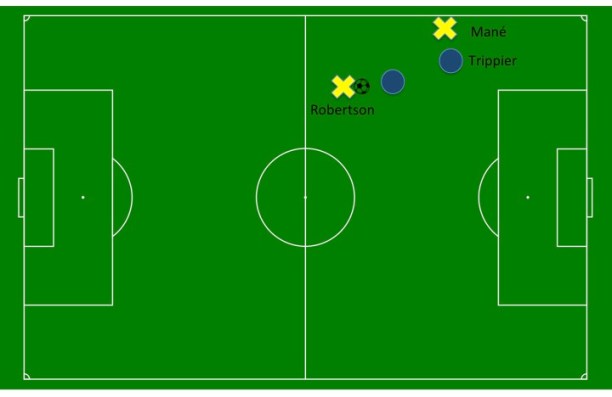
Diagram 1

Slide1

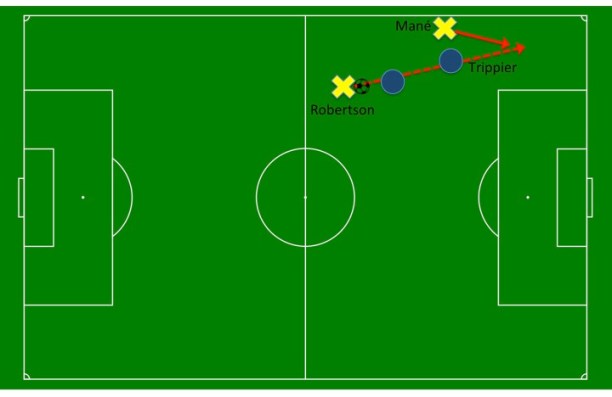
Kieran Trippier’s defensive position is quite tight on Mane. Possibly looking to intercept the pass if it is made to Mane’s feet. However, in doing so, he is susceptible to the ball over the top.

Diagram 2

Slide2.jpg

Instead of playing the ball to Mane, Robertson plays a left-footed ball over the top. Before Trippier can turn, Mane is getting clear.

Diagram 3

Slide3

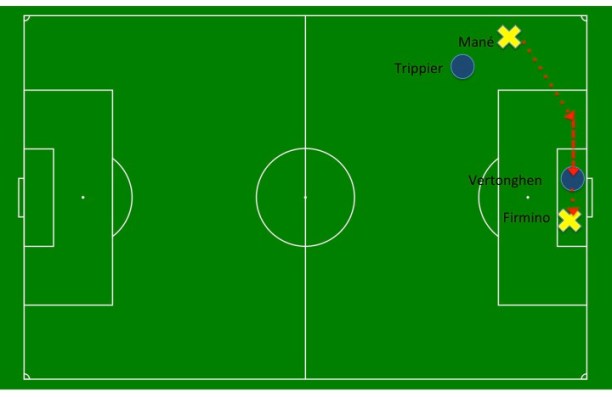
Trippier has lost goal-side position on Mane. Mane is now unopposed and running into the box. Vertonghen’s attempt to cut out the cross succeeded only in turning the ball against the post and Vorm was on the floor as the rebound rolled his way. He could not adjust in time, the ball squeezed through his hands and Firmino had an easy tap-in.

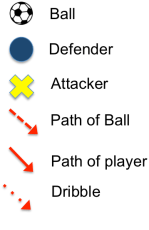
Key:

key

The defining moment is when Robertson plays the ball over the top. Diagram 3 clearly shows that Trippier is no longer able to provide any defensive resistance. This scenario is a common enough one and questions whether Trippier has really taken full ownership in terms of his responsibility for the marking of Mane. There is no one else who could possibly adopt this role other than Trippier.

At this moment in time, or rather while the ball is still with Robertson, Trippier should be taking sole responsibility for the marking of Mane. Effectively, he should be adopting a man-to-man marking role on Mane.

These one-on-one situations are being repeated time and again in different areas of the field. There is a split-second moment when the defender has to make the decision that this opponent is my responsibility, at least for the remainder of the particular phase of play. In order to be responsible for that opponent, one has to be goal-side of the opponent. Trippier cannot possibly be deemed to be in control of the situation. The consequences for not being goal-side are clear for all to see in the case of Liverpool’s second goal.

The mind-set of the need to maintain a goal-side position is often brought into question by players higher up the pitch. Hunting the ball in these areas, you will often see a player make an effort to win the ball but with no real thought or responsibility given to maintaining a goal-side position on this opponent. The attacking player slips the tackle and is now advancing with the ball and bearing down on the defensive unit. The defensive player who initially tried to win the ball has given up on this cause and left it to others to make good.

A pre-occupation with trying to win the ball is often the underlying cause of the attacker beating the defender. Ironically, the defender seems quite content with their work, having made an effort to win the ball. This is because maintaining a goal-side position is not regarded as being particularly important. But, it is the essence of good defending.

The habit can often manifest itself in and around the penalty box where the defender can be seen making a last-ditch lunge for the forward as they try to win the ball. The circumstances being, that the defender has not maintained a goal-side position. The defender is effectively on the wrong side of the attacker and is now trying to make amends.

It is fair to say that the concept of maintaining a goal-side position is not particularly ingrained into the psyche of modern day footballers. You might say, it never has been. The fact the defender finds themselves on the wrong side of the attacker is perhaps symptomatic of not making the decision to take sole responsibility for defending against this particular opponent in the first place.

The maintaining of a goal-side position has huge consequences in the strategy of playing the offside trap. Quite simply, a defender in the last line of defence with their back to goal could have an attacker alongside facing goal. The two are side by side. If a ball is played over the top of the last line of defence, it is quite clear who is going to get to the ball first. This is the harsh reality of prioritising a defensive line over the technique of maintaining a goal-side position.

Defences are quite good at catching opponents in offside positions. Likewise, attacking teams are becoming quite adept at beating the offside trap. Of course, the consequences of this strategy can be quite severe if the offside trap or defensive line is broken.

Upcoming blog – analysis of Premier League goals scored in the first week of the season.