Is maintaining a goal-side position a better option than trying to win the ball? — Oct 11, 2018

Is maintaining a goal-side position a better option than trying to win the ball?

Liverpool 0 Man City 0 – Premier League 7-10-18


Attempting to win the ball can become a habit.   It is not necessarily a good habit and it is commonplace in all aspects of defensive play.  Quite often it is executed in the midfield areas where there is the insurance that somebody else can tidy up if the tackle is missed.   Making an attempt to win the ball is seen as relatively positive and it can exonerate a player from further defensive responsibility in relation to the tracking of that particular opponent.   In terms of credibility, it seems to score more highly than this same player making sure they stay goal-side of the opponent.


Tracking back and potentially leaving the territory of one’s usual domain requires much hard work and commitment.   Taking full responsibility for the marking of an opponent during a particular phase of play may entail determined running in order to stay goal-side.   This is where the defensive habits are formed, or not formed, depending on your point of view.


The habit to make an early intervention with the view to winning the ball, if successful, will be very much applauded.   If it is not successful, the outcome is either placing an increased burden on the rest of the team or it could result in the conceding of either a free-kick or penalty.  Both of which are also placing high demands on the defensive unit.


Winning the ball higher up the pitch, is a much preferred use of this tactic.   Not only is it less risky for the defending team if the play is not successful but it could actually prove very effective in terms of creating a goal-scoring opportunity.   On a continuum from the attacking third to the defensive third, this strategy becomes increasingly more problematic.


What has all this got to do with the Liverpool vs Man City game?


Much of the talk following the Liverpool vs Man City game has been about the shocking late penalty miss from Riyad Mahrez.   For two teams that more or less cancelled each other out, the key moment in the game was when Man City were awarded a penalty.   Mahrez, after a dispute with Gabriel Jesus about who is taking the penalty, slams it over the bar.


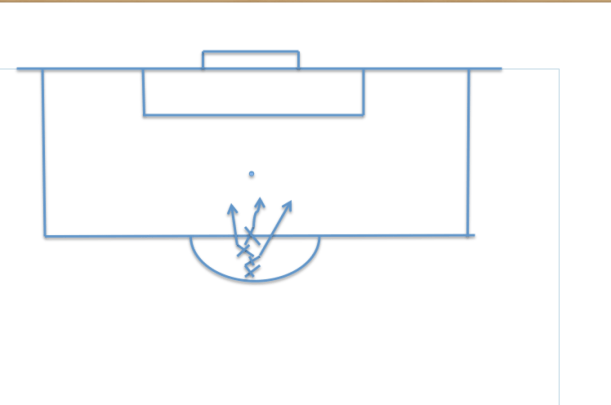
But I would like to talk about the awarding of the penalty in the first place.   Virgil van Dijk brought down Leroy Sane in the 85thminute in an attempt to win the ball.   The City substitute was heading towards the bye-line in the penalty area and the defender opted to try to win the ball in favour of maintaining a goal-side position.


There is a propensity among footballers generally to want to win the ball.   This seems to be ingrained in the mind-set.   It is their dominant response when faced with the situation of one against one.


The winning of the ball and the maintaining of a goal-side position are two diametrically opposed strategies.   The stakes are that much higher in the penalty area but also opposition forwards are looking to capitalise on any movement by the defender towards the ball.  Wily attackers are trying to draw a foul from any kind of contact, which could be construed as foul play.


This makes the strategy of trying to win the ball a very dubious play by a defender in the box.  Invariably, you hear the cry from more savvy ex-players willing the defender to “stay on the feet” which is another way of saying, “don’t dive in”.


By staying on one’s feet, the technique the defender is trying to impart is to firstly anticipate the release of the ball in the form of either a shot or pass.   In this case, Sane was shaping to shoot.   Whether it is a shot or pass the defender should try to get a block on the ball.   The angle that Sane had for the shot was quite acute and Virgil van Dijk’s body shape ought to provide a useful cue to his goalkeeper.   Even if the defender cannot block the shot, there should be sufficient information for the goalkeeper to glean what side of the goal the ball may be headed.   The defender ought to have secured the option of a shot to the

near post for the goalkeeper to contend with.


This whole approach turns the idea of trying to win the ball on its head.   Now, the defender is responding to the initiative by the forward rather than the other way around.   The defender is not going to be drawn in to trying to win the ball.  Instead, they are biding their time, not committing, waiting for the forward to take the initiative but ready to counter that play with good positioning and body shape to either block the shot or provide an appropriate communication with the goalkeeper to save the shot.


Van Dijk did not win the ball.   Sane was able to keep himself between the defender and the ball.   Virgil van Dijk was stretching in his attempt to win the ball but he later offered an honest statement:


“It’s not smart for me to dive in there.   I know it.  I wouldn’t do that normally but, obviously, there are so many things that play in your head at that time.   I’ll learn from this and, hopefully, it’ll never happen again.”

They’re all wanting to, join in, on the love train — Aug 7, 2018

They’re all wanting to, join in, on the love train

With inspiration still fresh from the exploits of the England team in Russia still uppermost in our minds, the opening games from the Sky Bet Championship have seen both Leeds United and Aston Villa utilise the love train routine to good effect.


On Sunday, the new-styled Leeds team under Marcelo Bielsa surprised Stoke with their intensity and scored their third goal from an in-swinging corner freeing up Cooper to rise imperiously from the back of the love train, unmarked, to head home.  Final score: Leeds 3 Stoke 1.


The Monday night game saw Villa travel to Hull where the home side grabbed an early lead with a Evandro looping shot from the top of the box.   Aston Villa’s equalising goal came just seven minutes later as Tommy Elphick, losing his marker at a corner, courtesy of the love train, scored with a close-range free header.   Final score: Hull 1 Aston Villa 3.


Following the posting made during the World Cup, I have been asked to explain why the love train is unstoppable.   It is a simple fact that in this type of team sport when a player vacates a space they leave another space behind them where, for a limited amount of time, a fellow teammate entering this space will be unmarked.   To safeguard this space in a congested penalty area where almost anything goes, it is wholly appropriate to utilise other teammates to create a slightly larger and more protected space.


The love train really needs a minimum of two players but ideally four, as England used, so the front three move forward and create the space behind for the fourth player to get the free header.   One of the key ways for opposition players to disrupt this routine is by boarding the train.   This tactic was used particularly by Panama and later Colombia at the World Cup.  England soon realised that they didn’t just have to line-up one behind the other.   It was necessary to actually hold on to the player in front thus using one’s arms to prevent penetration into the line from an opponent.   In so doing, the love train members retain the inside position as the train moves off.


All this, of course, is dependent on the pin-point accuracy of the corner kick which has to be driven to the target area.   In Ashley Young and Kieran Trippier England had two players, one from either side, who could provide this exceptional skill.   There is a way of stopping the train but, as yet, I have not seen a team implement such a strategy.


In football, you will often hear that a certain player, Ronaldo or Messi, is unplayable.   Here, in the context of the love train, I’ve used the term unstoppable.    Some have suggested that there is a sporting gene.   This is defined by someone who doesn’t accept the word can’t.  It applies to terms like unplayable, unstoppable.


There is a way of stopping the love train.   The following may be regarded as unconventional but it will stop the love train in its tracks.   The defensive solution is to build a wall.   A defensive wall as though you were defending a free kick and it should be positioned directly adjacent to the lead player in the love train.   The wall has to be tight and firm.


Whilst this is unconventional, there are no rules preventing a team from doing this.   Attacking players are prioritising their space in the formation of the love train.   Defensive players can do likewise by lining up a row of players at right angles to the train.   Knowing the love train is going to move forwards, the wall will prevent this from happening.


But, this is not the end of the story for all you love train lovers.   The sporting gene suggests there must be another way.   From my basketball playing days, trying to escape one’s marker to receive a pass in such a confined space is a constant challenge.  In order to achieve this it is necessary to give out false information to your opponent.   In other words, let them think you’re going to do one thing but, in actual fact, you’re going to do something completely different.


At this moment in time, the love train is in its infancy.   It is a new strategy that’s not been seen before this summer and people are trying to come to terms with it.   Specifically, how to combat it but, also, now the cat is out of the bag, how to implement it.


The love train participants need to send out false information to their opponents.   Instead of getting in position early and making it quite obvious what is about to happen, the players need to just mill about in the general area looking quite disinterested in the proceedings but keeping a very astute eye on the corner- taker.   Just as the corner is about to be taken, the players suddenly fall into line.  With split-second timing the defensive team will not have time to react and the love train will once again be up and running.


A seasoned opponent proves too much for England — Jul 13, 2018

A seasoned opponent proves too much for England

World Cup semi-final – Croatia 2 England 1 aet


Before the semi-finals I had a premonition that England were going to play Belgium.   I don’t know if this was to do with them being in the same group but I was rather hoping it was going to be in the final, not the 3rd-4thplay-off game.


England got off to such a good start against Croatia with the peach of a free-kick from Kieran Trippier after five minutes.    It was clear from the off that Croatia were going to press England and, unlike in previous games, they opted invariably to play the ball long.   The idea was to try and release Raheem Sterling who was playing high on the last defender.   The strategy of playing out from the back was not completely abandoned although it did seem the occasion of a world cup semi-final or the quality of the pressing Croatian team might have had a bearing on this.


The long ball strategy to Sterling did cause Croatia a few problems but unfortunately did not result in any goals.   It also had the effect of a much more expansive game which Slaven Bilic appearing pitchside before the game, was cautiously expressing his delight in that this type of game would play to Croatia’s strengths.   A more open game is not particularly what you want when you are 1-0 up.   There were some early long balls from the goalkeeper Jordan Pickford that seemed a good idea to get the ball up front quickly.   He was electing to kick long quite a lot of the time.   England were also often winning the second ball but were not able to maintain possession for sufficiently long enough periods in the middle third.


In the second half the game turned in Croatia’s favour.   Luka Modric was starting to control the game from midfield and this was forcing England’s wing-backs into more defensive positions.   The flank down Croatia’s right-hand side in particular seemed to provide the full-back, Sime Vrsaljke, with space to roam.   In fact, this area was the source for their equalising goal.  A deep cross was sent over towards the far post and Ivan Perisic, showing predatory instincts managed to get his left boot to the ball ahead of Trippier and Walker on 68 minutes.


In some ways the goal conceded was not too dissimilar to the goal England conceded to Tunisia.   Kyle Walker was exposed on that occasion by just not being aware of opponents ghosting in from the far post area.  Walker had provided an exemplary performance up to this point.   His speed across the ground was able to meet any threat comfortably.   He had managed to get his head on balls from corners to clear the danger.   He even managed to block one shot with an area of your body that you would rather keep protected.   But this particular aspect of his game is a cause for concern.


This sort of detail, understanding exactly how to mark opponents in these situations is as important to the team’s overall effectiveness as preparing a free-kick or corner routine.   It may be a product of him not being use to playing as a centre-back although John Stones was later to fall foul of a not dissimilar marking mix-up.   Roy Keene talks about the need to smell danger and be more alert in this type of situation.   It certainly involves a special sort of awareness.


England were, by now, on the back foot.   Perisic, probably their best player, struck the post as extra time loomed.   The idea of Croatia tiring and the youthfulness of England players would shine through did not seem to materialise.   In fact, it was the other way round.   Stones saw a goal-bound header cleared off the line in extra time, courtesy of the ‘love train’ routine before the decisive moment that came in the 109thminute.   A poor clearance from England was not sufficiently acted upon (smell danger!) as the ball was returned to the unmarked Mario Mandzukic in the penalty area.  This time it was John Stones who had failed to spot the danger.   His feet seemed to be rooted to the ground.   There was no anticipation in covering around his teammate on that side.   Mandzukic, completely unmarked was able to find the corner of the net despite the advancing Jordan Pickford.


Two goals from open play by Croatia.   Sometimes games are won and lost by the finest detail.   Not scoring a second goal in the first half is clearly a factor and these goals might both be regarded as soft goals to concede.   But conceded they were.   Whether you regard them as soft or not, it is right to try to understand the reasons or potential errors in technique of players defending in these situations.   The sensing of danger may develop with experience but the answer is more fundamentally rooted in the playing of zonal defence.    In both cases, defensive players are holding a space in their zonal shape as an attacking player arrives.


For those familiar with this blog, I will lift a paragraph from “The perfect antidote to countering Pep Guardiola’s title-winning tactics” posted earlier this year to reiterate the point.


“The problem with zonal marking is that most of the time there is no particular responsibility to be marking an opponent and then, boom a player needs marking!   This is because there is often a blurring of the line between holding a space and marking.   The defensive player is caught in two minds.   Confusion arises.   The centre-back and the full-back, for example, both think the other is covering and yet neither of them are covering.   The forward is left unmarked”.


This is what happened to England.    This is what cost them a place in the world cup final.   If you ask me, it is not the scoring of goals we need to panic about, but the conceding of them.

More of “The Love Train” for Croatia please. — Jul 9, 2018

More of “The Love Train” for Croatia please.


cropped-football-157931_64011.png


Set plays at the World Cup


The world cup has seen a high percentage of goals scored from set-pieces.   England have a corner-kick routine that is unstoppable.


A concept using the basketball ‘stack’ at the top of the box, it is a routine known as out-of-bounds play designed to free-up a player to receive the inbound pass.   The same principle is being used by England from corner-kicks where they target one of their big men to, hopefully, get a free header on goal.


Opposition teams know about it and what to expect but are unable to do anything about it.   It was a little disconcerting in the Colombia game where the England players were being intimidated and allowing the opposition to disrupt their set play.   At half time, the team re-grouped and came up with the idea of the ‘love train’ to eradicate Colombian interference in their set piece.


The defence cannot really do much about it, except foul.   Harry Kane was once again wrestled to the floor, as was the case against Tunisia and Panama.   The referee had no hesitation in pointing to the spot.   Despite the long delay before the penalty kick could be taken, Kane duly obliged in the 57thminute.   This was an ill-disciplined match with Colombia making their intentions clear from the off.   Yerry Mina, Colombia’s 6’5” centre back levelled the score with a powerfully headed goal, also from a corner, after 92 minutes taking this game to extra time and penalties.


We know what happened then!


How the Love Train works.

Screenshot 2018-07-09 16.53.33

By physically holding on to the teammate in front of you, or at least getting ‘touch-tight’ with your own teammate, it prevents an opposition player getting in between the stack of offensive players.   Although in the case of Colombia, one player was able to do just that.   However, in his enthusiasm to mark Harry Kane, the man-handling that ensued resulted in the penalty kick being awarded.


The players at the front of the love train break forward and effectively create a screen for the fourth player who finds himself in space.   Harry Maguire was the player freed up to score against Sweden.   John Stones has been the beneficiary in group games and Harry Kane is also coming off this stack and ready to feed off any rebounds or mis-directed headers as was the case for Harry Kane’s injury time winner against Tunisia.


The goal that England scored against Sweden was their first corner kick of the game.   It was a corner kick that was needlessly conceded by Sweden and it appeared that Emil Forsberg was given the job of marking Maguire.  The seven-inch height advantage of the England talisman made his task all the more difficult.


Corners or free –kicks have led to seven goals for England in this tournament and player selection is an integral part of this process.   In open play I have thought that Danny Rose is preferable at left wing-back but, on reflection, the quality of the set-piece ball from Ashley Young can be a game-changer.   His technique of using the top of his foot to hit a hard, flat delivery was key to Maguire’s opening goal against Sweden.


England’s wing-backs have been pivotal to the team’s progress so far.   Kieran Trippier also has a pin-point delivery technique from the other side when taking corner kicks.   The quality of his crosses in open play is also of the highest calibre.  If these players can hit the spot with a drilled cross in the corner-kick set plays, England can be fairly sure of a free header using their love-train routine.


As regards Croatia, they have now played two games of 120 minutes in six days as well as two draining penalty shoot-outs.   England are a young team and as the tournament reaches these latter stages fitness and energy levels are going to play an even bigger part.


Jordan Henderson, who turned 28 last month, “has covered 45.1km in his 385 minutes of football at this tournament, behind only Jesse Lingard an eye-catching 46.14 km in 362 minutes and John Stones 45.94 km in 435 minutes”.   Dominic Fifield – Guardian.


The running ability of our midfield players is likely to play a significant part in quelling the play-making skills of Modric and Rakitic who lift Croatia’s play to a different level.


For all the so-called lack of experience, the youthfulness of this England squad and its grounded temperament with no high-voltage egos to disrupt proceedings, the togetherness of the players could well prove decisive in the forthcoming week.   This has undoubtedly been Gareth Southgate’s stamp on this England team.


Come on England!


England Expect – World Cup Russia 2018 — Jun 18, 2018

England Expect – World Cup Russia 2018

Ahead of tonight’s first major tournament appearance since losing to Iceland in Euro 2016, it could be worth reflecting on the defending champions opening group match yesterday which ended in a 1-0 defeat by Mexico.

Prior to this game the pundits were discussing the Mexican coach, Juan Carlos Osorio, and finding it a little difficult to comprehend that he actually changes tactics ‘during a game’.  What was perhaps more alarming is the fact that his opposite number Joachim Low was unable to.   Time and again Mexico counter-attacked against Germany, who were being completely outnumbered at the back.   Had the finishing and final ball of Mexico been of a higher quality they could easily have scored five.

The high tempo and speedy transitions that Mexico managed in the first half together with the goal from Hirving Lozano after 35 minutes was unsustainable in the second, but still Germany were getting caught out at the back.   Herein lies the conundrum for tournament football at this level.   The more cultured, possession-style football of the Germans against the highly skilled but nonetheless unfavoured Mexicans with their underdog status, displayed an exhilarating performance showing real desire.   Where one team is expected to dominate possession (which England is tonight) their opponent can allow these teams to come onto them with a well organised defence and then hit them on the counter.

To play a controlled, possession-style type of football in the final third you do need to commit numbers forward.   The numbers are able to fulfil specific roles and therefore patterns of play to hopefully unlock the defence and score a goal.   Both German full backs were playing high up the field so were not at home when Mexico countered.   With at least three Mexico players breaking and, at most, two German central defenders holding the fort, it is easy to see how Mexico were able to make use of the space and create chance after chance.

England will be playing three at the back and mostly these three will be staying at home.   This is in contrast to Germany’s four at the back, on paper, but only two at home.   Even so, depending on the trickery and ball skills of their opponents this could prove difficult for England as the three at the back are not the most mobile.

Of much greater significance for England in tonight’s game could be their declared tactic of playing out from the back.   Tunisia, under coach Nabil Maaloul, may well pre-empt this tactic and apply real pressure to England’s backline.   In such circumstances, it is necessary to adapt one’s game accordingly.  Pressurising England’s backline would involve Tunisia committing numbers forward leaving them vulnerable behind their front line of defence.    In these situations, the long ball can be a very astute tactic and whilst it does not meet the playing out from the back criteria, it will avoid the potential risk of having the ball stolen in front of your own goal and with it, the prospect of going 1-0 down.   Sometimes, it is necessary to change tactics during a game!

The England manager, Gareth Southgate, has stated, “The first thing is to have a really clear understanding of how we want to play.   Stick to your principles, whatever the state of the game”.   This will involve playing out from the back as well as seeking to monopolise possession.   What England are possibly lacking as they embark on their 2018 campaign is a level of self-confidence and an opening goal at the other end could do wonders.

My prediction is 2-0 but not sure who to?

The perfect antidote to countering Pep Guardiola’s title-winning tactics — May 14, 2018

The perfect antidote to countering Pep Guardiola’s title-winning tactics

I sometimes wonder if there isn’t a conspiracy saying ‘let’s not do well ordered marking of opponents because that will reduce the number of goals being scored and we don’t want that’.   Maybe, it is my background in basketball whereby every player has to be accounted for when it comes to marking.   Anyway, let’s concentrate on the football.

How Guardiola conquered the Premier League

Finding space between the lines has been an area of very fertile exploitation for some considerable time.  These lines are usually horizontal lines where players are able to receive the ball in space, often between the defensive backline and midfield.   Pep Guardiola’s interest has been more specifically with vertical lines or channels notably between centre-back and full-back.   These are similar tactics he used at Barcelona and Bayern Munich utilising the same basic idea of exploiting space.

Guardiola has players train on a pitch marked into 20 different zones.  Positional play is worked on through the principle that “no more than three zones in the same horizontal line and no more than two zones in the same vertical line should ever be occupied”.  Jonathan Wilson – Guardian.

pitch

Within this attacking format, players are expected to adjust their movement according to the position of the ball and thereby giving the player on the ball two options for passing.  This type of positional play is aimed specifically at teams who defend deep and well.   It demands not only high quality preparation but also a touch of individual creativity.

One of Guardiola’s other fundamental concepts is the 15-pass build-up.    Possession, he believes, is only a means to an end.   Fifteen passes is crucial to what the team plan to do higher up the pitch.  The fifteen consecutive passes in the middle of the field is to allow players to set up in their offensive structure.

This whole philosophy is based on and pre-supposes that opposition teams will defend zonally.   This is a fair assumption as most teams, if not all teams, do defend zonally.   Teams will set up in various formations that have become so diverse to be almost meaningless.    These might be anything from 4-2-3-1 to any combination of numbers that add up to ten.   Coaches, generally, are becoming increasingly measured in their attempts to outwit defences that show little ambition for venturing forward.

One of the reasons that enabled this creativity is the predictability of the opposing formations.   It doesn’t matter what the formation is or how the team intend to implement it, the commonality is that they are all zonal defences.   Inevitably, this will involve a flat backline with the expressed intention of keeping this line straight.

A false sense of security

It’s high time for defences to respond and also become more creative.   Get away from the zonal defence as being the only form of defence.   If a team could set up defensively in a different format it would certainly put a spanner in the works for opposing teams’ game plans.  There is an alternative to zonal defending.

The team man-to-man defence places far greater emphasis on the need to apply pressure on the ball-carrier.   The whole point of team man-to-man is to ensure that there is at least one other team member available to support the player marking the player on the ball.   It is this that distinguishes this type of defence from the more common, distant relative of man-marking.   It is important to be clear on this.   The two concepts are completely different.   The popular myth is that it is a fool’s game.  Man-marking may be.   Not so with man-to-man defence where its expression is very much on the team element.

The problem with zonal marking is that most of the time there is no particular responsibility to be marking an opponent and then, boom a player needs marking!   This is because there is often a blurring of the line between holding a space and marking.   The defensive player is caught in two minds.   Confusion arises.   The centre-back and the full-back, for example, both think the other is covering and yet neither of them are covering.   The forward is left unmarked.

All too often defenders are left marking time rather than specific opponents.   It is true the idea of man-to-man goes against conventional wisdom but changing the way we think may be necessary to understand what have become accepted norms.   The concept ought not be so terrifying as even with zonal defending, there comes a point when a defender has to make a decision to mark a particular individual.  Often, this decision is either not made or it is made too late leaving the forward unmarked in front of goal.  It may only be a split-second moment and that is why it makes sense to reduce any uncertainty by completing the allocation of marking responsibility early on in the phase of play.

Man-to-man management

It is not possible to abandon zonal defending in favour of man-to-man defending.   This is not what is being suggested.   On the contrary, zonal defending provides the basic structure from which to implement man-to-man.   In the same way it might take the attacking team fifteen passes to set up their attacking shape, this is a useful amount of time to set up your defensive shape.  The process involves switching from zonal to man-to-man.

The man-to-man system is probably not a viable option to use against those teams favouring a more direct type of attacking football.   Marking allocation is best effected from a zonal format where initial coverage of the playing area is prioritised in the first instance.   A process of matching up one for one can start to take place in the middle of the field that eliminates uneconomical running with some players chasing their opponents all over the park.   The matching-up process would be based on respective opponents operating in similar areas of the pitch.   This player then becomes the marking responsibility for the duration of that phase of play.

The Zonal Press in Basketball

Pressing has been a key element of basketball strategy for years.   There are various types of press but the one I favoured was the 1-2-1-1 zone press.

pitch2

The initial set up is in a zonal shape and this can move very quickly in to man-to-man as the play unfolds.   The 1-2-1-1 press has good coverage of the court as the ball is passed in following a score from the pressing team.   Players will then move from these initial positions to mark opposition players according to their proximity on the court.  The shaded areas represent an easy pass in for the opposition and the ‘2’ of the 1-2-1-1 each have a responsibility to pressurise the pass into these areas.   An alternative pass is the long one down the court and this is even more risky than the long ball in football.   The ‘1’ at the back can deal with this ball.   The ‘1’ at the front is pressurising the ball being passed in which leaves just one other who is looking for the fourth man.

This is the fundamental principle of zonal defending that you move from your initial starting position to mark an opponent.   In football, where there are double the numbers of people involved and the fact that the playing area is twenty times the size of a basketball court, it makes the task more difficult.

Whilst the sports of football and basketball may seem very different, the principles of zonal play are the same.

Team man-to-man provides support for the player on the ball

Even though you have been allocated one player to mark, there is still a requirement to provide cover for the teammate marking the player on the ball.   The level of this support will be determined by the proximity of one’s marking player to the position of the ball.   If this player is within ten metres of the ball, the level of support is going to be much greater than if they were fifty metres from the ball.  The distance from the ball, and therefore the precise level of support one can provide, is determined by the amount of time it would take to be back in touch with your marker if the ball was switched to them.   This same principle of adjusting one’s position according to the position of the ball is also at the heart of Pep Guardiola’s attacking play.

Johan Cruyff once asked, during Guardiola’s spell as coach at the Camp Nou, “Do you know how Barcelona win the ball back so quickly?    It’s because they don’t have to run back more than ten metres as they never pass the ball more than ten metres”.   If that still holds true then the level of support around the ball can be quite intense.

More tactically flexible

There are numerous benefits to playing man-to-man defence and in the context of this debate the beauty of this particular defensive strategy is the elimination of these pockets of space, at a stroke. The pockets that have eluded the zonal marking structure and are the catalyst for the fluency and drive of this Manchester City team no longer exist.

It is difficult to defend against City if you insist on playing with your zonal shape.    Their movement and pre-set attacking patterns are all based on the opposition playing in a particular way.  Teams, who are concentrating on this defensive shape in their keenness to get players behind the ball, often neglect to meet the most important principle of defending which is pressure on the ball.   This particular quality is the cornerstone of team man-to-man marking.

The issue about when to go to the player and when to hold the space is a recurring theme.   At least it is with zonal marking.   It is not the case with man-to-man marking.   The decision about who to mark has been sorted out long before.  The fact that defensive responsibility has been individually assigned means that you also now have accountability.  Man-to-man defence provides the fundamental base for all types of team defences.   It permits the marking up of opponents, fixes responsibility and encourages player pride in the development of individual defensive abilities.


Go back

Your message has been sent

Warning
Warning
Warning
Warning

Warning!

The Journey Begins —